

This issue from PRINTING United Alliance features articles on how to perform better root cause analysis and how to install more effective countermeasures. The practice of continuous improvement offers printing and graphic communications companies a way to create a sustainable competitive advantage.
Articles in this issue:
Six Ideas for Preventing Human Error
John Compton
Often in our industry, quality failures and accidents are described as being due to human error. While at some level this may be true, it’s not very helpful. It’s somewhat like saying that falls are due to gravity. It acknowledges that workers, like all human beings, make mistakes. It does nothing to prevent recurrence. We must understand that human error is a symptom of more fundamental problems in the organization.
There are two basic approaches to the problem of human error: the person approach and the system approach. The person approach assumes that people make errors because of weak mental processes such as forgetfulness, inattention, carelessness, and poor motivation. The most common countermeasures in this approach focus on the person who committed the error with the goal of reducing the unwanted behaviors. Actions resulting from root cause analysis in this case include the 4 R’s: remind, retrain, reprimand, and replace.
The system approach recognizes that humans are fallible and errors are to be expected. Errors are seen as consequences, not causes. There is an understanding that there are many performance shaping factors that are important causes of the errors that people make. Root cause analysis and countermeasures in this approach focus on the system, identifying and reducing the many performance shaping factors that are the underlying causes.
Common performance shaping factors include:
- Training and Experience
- Standard Procedures and Administrative Controls
- Ergonomics and Human Machine Interaction (Interface)
- Time Available for the Task
- Complexity of the Task
- Workload, Stress, and Stressors
- Environment (noise, heat, light, etc.)
- Fitness of Person for Work (physical, mental)
- Work Processes (team, staffing, communication, safety, planning, etc.)
There are hundreds of performance shaping factors (PSF). Each alone is not usually responsible for an error. The effects of several factors combined add up and can lead a person to commit an error. Human error is seldom a cause and nearly always a symptom of more fundamental problems. Through better thinking we can uncover and address problems in the system that make errors more likely to happen.
Here are six simple ideas for better root cause analysis and more effective countermeasures.
1. Focus on the error chain as you conduct root cause analysis.

Every error results from multiple causes or contributing factors. Errors happen when these come together to form an error chain. The focus of any problem solver must be to find and act on as many contributing factors as possible. This includes implementing countermeasures aimed at underlying performance shaping factors. This leads to a culture of problem solving as opposed to a culture of blame.
2. Use the 5 Whys to discover underlying causes of an error.

By asking the “why” question five times during root cause analysis and thinking through the answers, the underlying forces leading to the error can be uncovered and addressed. The goal is to look below the surface and to be on the lookout for root causes, keeping performance shaping factors in mind. It usually takes at least five and maybe more “why” questions to get deep enough into the system-related issues to discover root causes.
3. Identify high-risk steps and activities.

Errors can occur at any stage of an operation, but mistakes made at certain high-risk steps can lead to major problems.
Conduct a process failure modes and effects analysis (PFMEA) on those processes that are critical to quality and customers. Implement mitigation actions at critical points to reduce the high risk of incorrect actions and decisions.
4. Implement the use of checklists.
Checklists dramatically reduce errors and omissions as well as improve safety. Doctors and pilots make regular use of checklists to avoid errors. Even basic tasks can benefit from the use of a checklist.

5. Reduce the complexity of the work.
The greater the complexity and number of variables in a system, the greater the opportunity for errors to occur. Consider two operations, the first has five steps and the second has 20 steps with each step performed correctly 99% of the time.
Many of the tools of Lean are intended to reduce complexity by identifying and removing unnecessary steps and other forms of waste. Furthermore, shortening the length of time products are in the production process through eliminating non-value creating steps decreases the likelihood of errors as well.
6. Use visual controls.
The use of visual controls and single-point lessons at critical points can significantly reduce error risk. Avoid densely written procedures and work instructions. Visual controls have shown to be very effective at helping people do the right things and make the right decisions.

Final Thoughts
Human errors are inevitable. An individual perspective looks for explanations of causes in people. “Who did it?” “What can we do about them?” The systems approach looks for explanations in the wider system. “What system factors influenced the event?” “What can we do to reduce the likelihood of a similar event?” The systems approach looks at individuals but also procedures, practices, technology, communication, culture, and a variety of performance shaping factors.
John Compton is a former quality executive in the printing industry, professor emeritus at Rochester Institute of Technology, and the conference consultant for PRINTING United Alliance’s annual Continuous Improvement Conference. He is available through the Alliance to assist companies with CI and Lean initiatives.
How Not to Be a Conclusion Jumper
Jim Workman
Do you think that sound problem solving underpins any successful continuous improvement initiative? Author and consultant Dan Markovitz is sure of that truth. Markovitz presented the session “Making Better Decisions” during PRINTING United Alliance’s CI Ready! virtual event this April. Much of his content was drawn from his recent book, The Conclusion Trap, which followed two other award-winning efforts, A Factory of One and Building the Fit Organization.
Markovitz contends that a staggering waste of money and opportunity is caused by a knee-jerk approach to problem solving. He explained the relevance of psychologist Daniel Kahneman’s groundbreaking work on the dichotomy of fast automatic thinking versus slow analytical thinking. According to Kahneman, humans have two primary modes of thinking, with unconscious fast thinking (which he refers to as System 1) predominating in everyday decisions. It is this fast-thinking mode that is activated, for example, when a person jumps backwards from the sound of a rattlesnake’s tail. It is also more error prone than System 2, a thought process that is deliberate, conscious, and prepared to deal with complex situations like determining which health care plan to select.
As Markovitz sees it, in order to deal with business pressures managers too readily default to System 1, making snap decisions and ending up with half-baked solutions. He nicknames System 1 and 2 “jumping” and “analyzing.” People might think of themselves as careful thinkers, but much of the time they are conclusion jumpers, which can lead to all sorts of negative outcomes. While it’s human nature, Markovitz’s talk was about how to fight that tendency during critical problem solving.
There are three common traps when business leaders haven’t carefully analyzed a problem, according to Markovitz:
- They invest in technology. Technology almost never fixes problems, says Markovitz. It just makes broken methods faster. When technology is suggested as a solution to a problem it usually indicates that people probably don’t understand the problem.
- They spend plenty of money. If you’re about to spend a lot of money, stop. Ask yourself if you truly know the causes of your problem, found by using the four-step process explained below.
- They reorganize the company, which rarely works as a solution to a poorly understood problem. It’s incumbent upon executives to understand why value isn’t flowing smoothly to the customer before doing something so drastic.
One of these—technology, money, and reorganization—might be what a company needs, but often they reveal a short-circuited problem analysis and a hasty conclusion.
 Markovitz’s cure for avoiding simple, pre-packaged solutions is to follow his four-step process: go see, frame the problem, think backwards, and five whys.
- Go see. Just like in a police detective, managers must go to the crime—or problem—scene. The tendency is to make decisions from the office where we rely on data instead of facts. John le Carré, the spy novelist, made the same observation in one of his books: “The desk is a dangerous place from which to view the world.” When visiting the problem area, inquiries need to be humble and come from an attitude of curiosity and interest, lest they seem accusatory.
- Frame the problem properly. The problem statement needs to be carefully expressed. It must focus on the problem, not a symptom. “The patient has a fever of 102 degrees,” is a symptom statement; “The patent has a bacterial infection” frames the problem. Lazy thinking can also confuse a problem statement with solution statement. “The problem is that our sales team needs more administrative support” leads to an intellectual dead end—there is only one solution. A better frame would be “Our sales team spends 10 hours per week on low-level administrative activities.” The problem needs to be described in a specific way instead of in overly general terms. Other key aspects are the subject of your statement, measurements cited, and the choice of language (some phrases create bias in the approaches that might be taken).
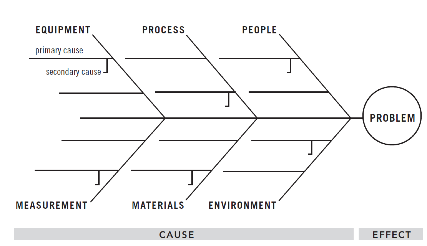
- Think backwards. The detective work to find potential causes requires structured thinking. A proven approach is to use the fishbone (also known as Ishikawa) diagram, as it provides a clean, graphic method of identifying potential factors causing a problem. As you can see, it looks like a fish skeleton, with the large bones each representing a main causal area, typically equipment, process, people, measurement, materials, and environment. Specific potential causes are added to each appropriate area of the skeleton. The fishbone diagram encourages you to “think backwards”—to look for the issues that underlie the observable problem.
- Five whys. Once a likely cause has been identified, it’s time to dig deeper by asking “why” multiple times. It might take three, five, or even eight questions to finally get to the root problem. Accepting the first answer as the legitimate reason will generally result in conclusion jumping. Said Shigeo Shingo, who helped develop the Toyota Production System, “A relentless barrage of “whys” is the best way to prepare your mind to pierce the clouded veil of thinking caused by the status quo.” Blaming a person or a failure to follow standard procedures at the end of questioning means the inquiry was too shallow.
The four steps presented by Markovitz build on each other and work powerfully together to help companies find effective and durable solutions to their problems. However, this kind of problem solving requires breaking cognitive behavioral habits when faced with a significant problem. Don’t default to the “jumper.” If you quickly set upon a clear, simple solution to a problem, the odds are high that it is wrong!
Jim Workman is vice president, technology and research for PRINTING United Alliance. He provides technical support to members and oversees the Alliance’s Continuous Improvement Conference, Pinnacle InterTech Awards, consulting services, as well as serving as managing director for the Technical Association of the Graphic Arts. You can reach Jim at jworkman@printing.org.
Dan Markovitz can be reached at dan@markovitzconsulting.com.
Culture Audit Tool
This quick, confidential assessment from PRINTING United Alliance is designed to help company executives improve their corporate culture. A healthy culture is related to overall company performance, which is why top companies monitor and manage their culture.
The audit tool asks you to respond to 32 short statements by indicating your strength of agreement or disagreement with each. Your answers should be based on how you believe your employees, on average, would respond. Once your responses are entered, the assessment provides a scorecard of what you have entered (please print this out for your records). You will also receive a link to a report so you can compare your responses to other executives.
Evaluating your company’s culture in this way should help you see opportunities for improvement. You can also use these questions to create a survey for your employees. Executives are often surprised to find that their perceptions are considerably different than those of their employees. A link to a survey template for employees is provided after you complete the Culture Audit Tool. To get started, visit https://prnt.in/cultureaudit.
Peer Group Openings
PRINTING United Alliance has openings in two peer groups. The CI Peer Group is focused on continuous improvement and is comprised of individuals (quality managers, CI directors, operations managers, etc.) that are engaged to some degree in continuous improvement and Lean management. The OpEx Peer Group discusses all things related to operational performance and Lean management and is made up of senior executives from medium to large printing companies that value networking, learning new ideas, and getting feedback on current challenges. Groups meet virtually and have one or two in-person meetings per year. Contact Jim Workman at jworkman@printing.org or 412-259-1710 for information.
Conference Registration
 The 2021 Continuous Improvement Conference (August 22–24 in Columbus, Ohio) is the only industry event focused on helping printing and converting companies achieve operational excellence by using the concepts of Lean manufacturing and other management and quality systems. Attendees directly link reduced costs, lowered waste, and increased profit margins to ideas gained from conference presentations and networking. Whether you’re starting a structured improvement program or are looking for ways to sustain and improve your existing efforts, the conference has content specifically designed for your knowledge level. To register and learn more about the event, visit ci.printing.org.
Continuous Improvement Newsletter is published quarterly by PRINTING United Alliance in support of its annual Continuous Improvement Conference (August 22–24, 2021 in Columbus, Ohio). Past issues are available at ci.printing.org/ci-newsletters. Send submissions and subscription requests to jworkman@printing.org.